

How to read a knitting chart
By Marlpin · Updated · 4 min read
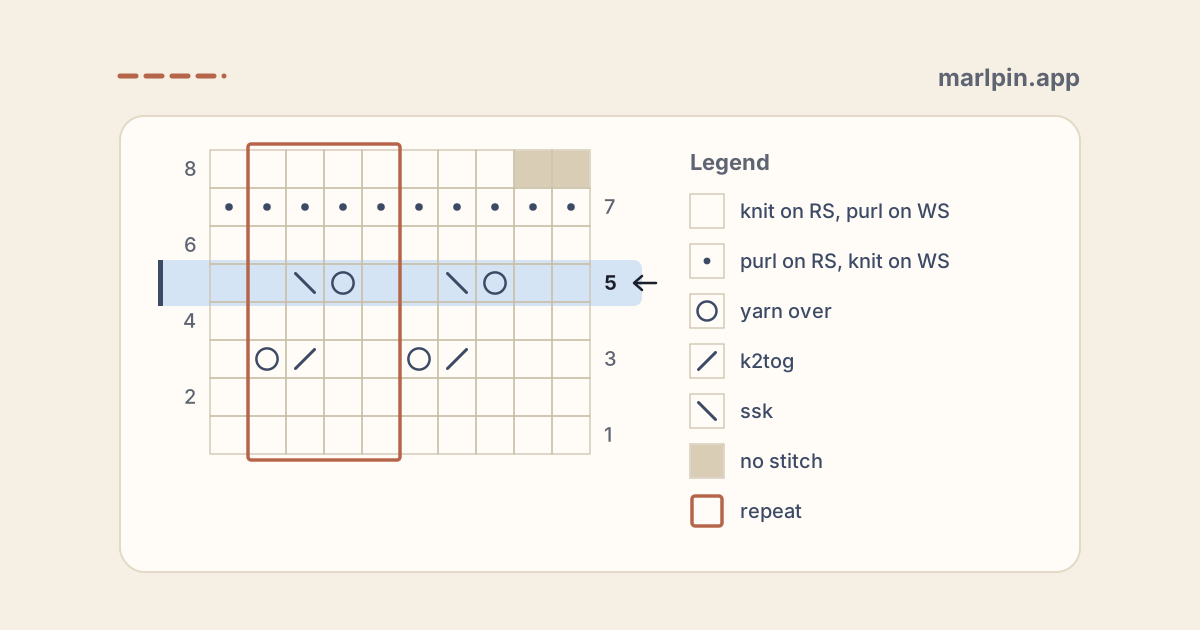
A knitting chart is a picture of your fabric seen from the right side: one square for each stitch, one line for each row. Read it from the bottom up, right to left on right-side rows, and keep the legend beside you. Work out the direction, the symbols and the repeat before you start, then follow it one row at a time.
How a chart is laid out
Each square is one stitch and each line is one row or round. You start at the bottom right and work up, because that's how the fabric grows (Interweave, Brooklyn Tweed, Tin Can Knits).
The row numbers tell you which way to read. Knitting flat, right-side rows (usually the odd ones) have their number on the right and are read right to left. Wrong-side rows have their number on the left and are read left to right (Interweave). In the round every round is a right-side round: all the numbers sit on the right, and you read every round right to left.
Charts are how most colourwork is knitted: in a 2019 University of Helsinki survey of 177 knitters, just over 60% always or almost always knitted multicolour designs from ready-made charts.
Read the legend first
Because the chart shows the right side, a symbol often means the opposite stitch on wrong-side rows. The Craft Yarn Council's standard key, with 36 stitch symbols, makes its blank square a knit stitch on the right side and a purl on the wrong side, and its dot the reverse.
| Symbol | What you knit |
|---|---|
| Blank square | knit on right-side rows, purl on wrong-side rows |
| Dot | purl on right-side rows, knit on wrong-side rows |
| Circle | yarn over |
| Line leaning right | knit two together |
| Line leaning left | slip, slip, knit |
| Grey square | no stitch: skip it |
Symbols vary between designers and countries, so a standard key is only a starting point: the legend in your pattern always wins.
Repeats and no-stitch squares
A heavy or coloured box marks the repeat. Work the stitches before the box once, repeat the boxed stitches as often as the row needs, then work the stitches after it (Interweave, Phildar). It's the chart version of the asterisks in written instructions.
Grey "no stitch" squares keep the grid lined up when the stitch count changes. Skip them: there's no stitch there to work (Brooklyn Tweed, Interweave).
In multi-size patterns, sizes can start and end at different points of the same chart. The pattern says where your size begins, so mark that column before you cast on (DROPS).
Charts in German and French patterns
German patterns call a chart a Strickschrift (or Diagramm) and a repeat a Rapport. Many chart only the right-side rows; the text then says how to work the wrong-side rows: the stitches as they appear, or in lace, every stitch and yarn over purled (Lana Grossa, Rico, Initiative Handarbeit). Some German patterns chart every row, so read the note under the chart (Lana Grossa).
French patterns call it a grille or diagramme. Phildar reads odd rows (rangs impairs) right to left and even rows (rangs pairs) left to right, and boxes the motif to repeat (Phildar). Bergère de France and DROPS describe the same: start at the bottom and read right to left on the right side (endroit) (Bergère de France, DROPS).
Keep your place
Most chart mistakes start with a lost row. Knitters lay a magnetic strip, highlighter tape, a sticky note or a ruler along the row they're on, often just above it so the rows already knitted stay in view (Knit Heart Strings, Interweave). Stitch markers between repeats show a miscount within a few stitches.
Mistakes to avoid
- Reading wrong-side rows the wrong way. Knitting flat, wrong-side rows run left to right.
- Forgetting the wrong-side meaning. A blank square on a wrong-side row is a purl stitch.
- Knitting no-stitch squares. Grey squares are placeholders; skip them.
- Losing the row. Mark it, and move the marker as soon as you finish the row.
- Skipping rows that aren't charted. When a chart shows only right-side rows, work the wrong-side rows the way the text describes (Tin Can Knits, Yarnstore).
Let Marlpin keep your place
Marlpin is our app for iPad and iPhone. Its row ruler holds your place on the chart in your PDF, and it tints your size in every instruction, without changing the file. It's coming soon to the App Store.
One email when Marlpin launches — no spam. See our privacy note.
Sources
- Interweave: How to read knitting charts
- Brooklyn Tweed: Reading charts
- Tin Can Knits: How to read a knitting chart
- Craft Yarn Council: Knit chart symbols
- DROPS: How to read a knitting diagram
- Phildar: Comprendre un diagramme
- Bergère de France: Point de jacquard
- Lana Grossa: Landlust 2024 patterns (right-side rows charted)
- Lana Grossa: Landlust 2022 patterns (all rows charted)
- Rico: Tuch aus Essentials Fine Fine Merino
- Initiative Handarbeit: Strickschrift
- Knit Heart Strings: Keeping your place in a chart
- Yarnstore: Strickschrift lesen
- University of Helsinki: 2019 survey of 177 knitters